Higher than 63% of images in the League. Master — Exceptional. Fewer than 1 in 10 reach this.
88.0510
✓ Apex DDI across 5 dimensions
✓ Expert review by Grandmaster mentor
✓ Final evaluation calibrated
Evaluated 14 Aug 2026 · Public
The five dimensions
Emotion
8.7↑
Your Strongest
Timing
8.4
Strong
Wonder Factor
7.6
Strong
Difficulty
7.2
Good
Visual Impact
6.8↓
Your Next Leap
Tap a dimension to see the engine's reasoning · All evaluations out of 10
SL evaluation distribution
058.0510
What Shutter League saw
▪ This places you in the top 18% of People images evaluated on Shutter League.
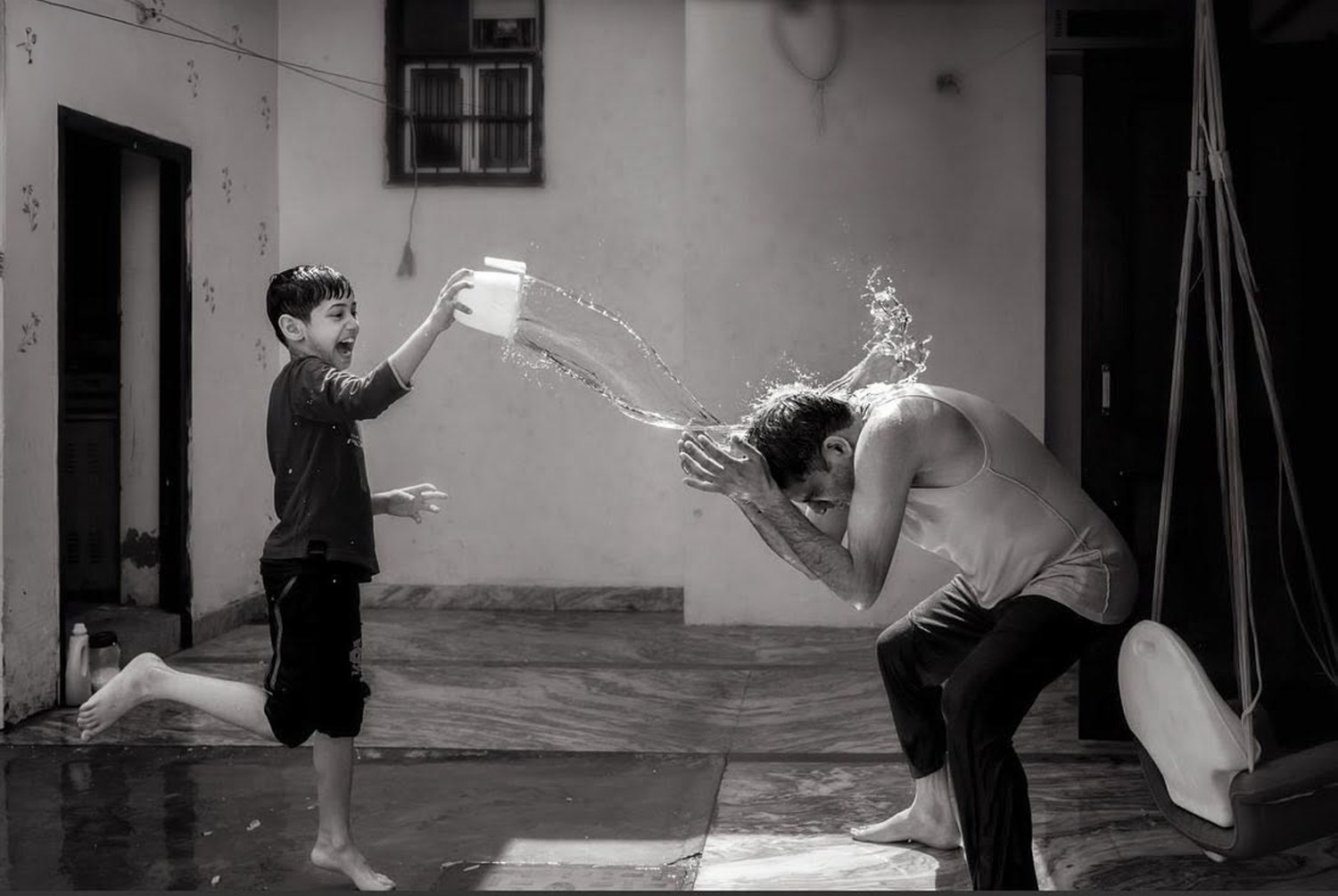
▪ A 9+ frame would have needed two things: a background with less visual clutter — the window, the doorway, and the hanging fabric are all competing for attention — and a tighter crop that removes the empty floor space in the lower third and brings the viewer closer to the subjects. Picture this frame: the same water arc and the same expressions, but the crop is from mid-thigh up, the background is a single clean wall, and the eye has nowhere to go except the connection between the child and the adult. That is the frame that wins.
▪ The habit that gets there: before you press the shutter, scan the edges of the frame for anything that does not add to the story — a stray object, a competing line, a bright patch that pulls the eye away from the subject. If it does not help, move your position or your framing to remove it. **Steve McCurry** built his entire practice on this discipline — every element in the frame either supports the subject or it is not in the frame. Search: Steve McCurry composition discipline.
SL Evaluation · Expert-calibrated
This places you in the top 18% of People images evaluated on Shutter League.
A 9+ frame would have needed two things: a background with less visual clutter — the window, the doorway, and the hanging fabric are all competing for attention — and a tighter crop that removes the empty floor space in the lower third and brings the viewer closer to the subjects. Picture this frame: the same water arc and the same expressions, but the crop is from mid-thigh up, the background is a single clean wall, and the eye has nowhere to go except the connection between the child and the adult. That is the frame that wins.
The habit that gets there: before you press the shutter, scan the edges of the frame for anything that does not add to the story — a stray object, a competing line, a bright patch that pulls the eye away from the subject. If it does not help, move your position or your framing to remove it. Steve McCurry built his entire practice on this discipline — every element in the frame either supports the subject or it is not in the frame. Search: Steve McCurry composition discipline.
Next time you are photographing children at play near your home in Bengaluru — at a park, in a courtyard, or during a family gathering — try this: position yourself at the child's eye level, use a shutter speed of at least 1/500s to freeze motion, and wait for the moment when the child is fully absorbed in the play and has forgotten the camera exists. That is when the real expression appears.
YOUR NEXT BODY OF WORK SEQUENCE: The story is everyday joy in domestic spaces. Frame 1: a child's hands mid-action — pouring water, stacking blocks, reaching for something just out of frame — shot tight so the hands and the gesture fill the frame. Frame 2: the same child's face in laughter or concentration, lit by window light, with nothing in the background except a clean wall or soft blur. Frame 3: the wide frame that shows the space they are playing in — the courtyard, the room, the light falling across the floor — so the viewer understands the world this joy happens inside.
The photograph you almost made is always better than the one you settled for.
Beautifully timed — you waited for the moment when the water arc was at full extension, the child's laughter was unguarded, and the adult was fully committed to the play, and all three variables aligned in a single frame.
Raghu Rai — his entire practice is built on this discipline: being present in the moment, camera ready, and waiting for the peak of the gesture rather than shooting through the buildup. His work with children in Indian domestic spaces shows the same instinct you applied here — the camera is invisible, the subjects are absorbed in their world, and the frame captures the truth of the moment rather than a performance for the lens. Raghu Rai children India.
This image has a story because it shows a relationship in action — the child trusts the adult enough to drench them with water, and the adult participates in the play rather than shutting it down. That trust and that participation are visible in the body language, and that is what makes the frame more than just a water-splash snapshot.
What stood out
Brilliantly timed — the water arc, the laughter, and the defensive crouch all peaked in the same instant, and you held the frame through it. This is the candid family moment that most photographers miss because they are setting up the shot instead of watching for it.
▪ Next time you are photographing children at play near your home in Bengaluru — at a park, in a courtyard, or during a family gathering — try this: position yourself at the child's eye level, use a shutter speed of at least 1/500s to freeze motion, and wait for the moment when the child is fully absorbed in the play and has forgotten the camera exists. That is when the real expression appears.
▪ YOUR NEXT BODY OF WORK SEQUENCE: The story is everyday joy in domestic spaces. Frame 1: a child's hands mid-action — pouring water, stacking blocks, reaching for something just out of frame — shot tight so the hands and the gesture fill the frame. Frame 2: the same child's face in laughter or concentration, lit by window light, with nothing in the background except a clean wall or soft blur. Frame 3: the wide frame that shows the space they are playing in — the courtyard, the room, the light falling across the floor — so the viewer understands the world this joy happens inside.
▪ The photograph you almost made is always better than the one you settled for.
Brilliantly timed — the water arc, the laughter, and the defensive crouch all peaked in the same instant, and you held the frame through it. This is the candid family moment that most photographers miss because they are setting up the shot instead of watching for it. The black-and-white treatment lets the gesture and the expression do all the work, and the courtyard light is clean and even across both subjects. What makes this frame rare is not the water splash — it is the fact that the adult is fully participating in the play, not just tolerating it, and that participation is visible in every line of the posture.
Your next shot — bookmarked
Cubbon Park near the bandstand area
Cubbon Park near the bandstand area is close by. Early morning between 07:00 and 08:30, families gather with children, and the light through the trees is soft and dappled. The frame worth making: a child running toward the camera with backlight creating a rim around the hair and arms, shot at 1/500s or faster to freeze the motion, with the trees falling into soft blur behind. The joy is in the movement and the light together.
Edit suggestions
Balanced · Light editing
Darken the background by one stop — the window and the doorway are pulling attention away from the subjects, and reducing their brightness lets the eye settle on the water arc and the faces.
Crop tighter from the bottom — remove the empty floor space in the lower third and bring the lower frame edge to just below the child's feet. This brings the viewer closer to the action and removes dead space that adds nothing to the story.
Burn down the bright patch on the right edge where the hanging fabric catches light — it is competing with the child's face for the brightest point in the frame, and the face should win that competition.
Artistic · Heavy editing
Convert to a high-contrast black-and-white treatment with crushed shadows and bright highlights isolated to the water arc and the child's face — this would push the image toward a graphic, almost silhouette-like rendering where the gesture and the light become the only readable elements, and the courtyard detail falls away entirely. The frame would feel more like a study of joy as a physical act than a documentary moment.
How this photographer is developingLast 19 photographs
League standing is determined by calibrated evaluation against the Shutter League standard. Standings reflect evaluated photographs only.
Terms & Conditions ·
Privacy Policy ·
Refund Policy