Higher than 84% of images in the League. Master — Exceptional. Fewer than 1 in 10 reach this.
88.4010
✓ Apex DDI across 5 dimensions
✓ Expert review by Grandmaster mentor
✓ Final evaluation calibrated
Evaluated 08 Aug 2026 · Public
The five dimensions
Wonder Factor
8.9↑
Your Strongest
Difficulty
8.7
Strong
Emotion
8.6
Strong
Visual Impact
7.8
Strong
Timing
7.4↓
Your Next Leap
Tap a dimension to see the engine's reasoning · All evaluations out of 10
SL evaluation distribution
058.4010
What Shutter League saw
▪ Master tier means the technique is no longer the challenge — you can execute panning cleanly and consistently, and the image shows that control.
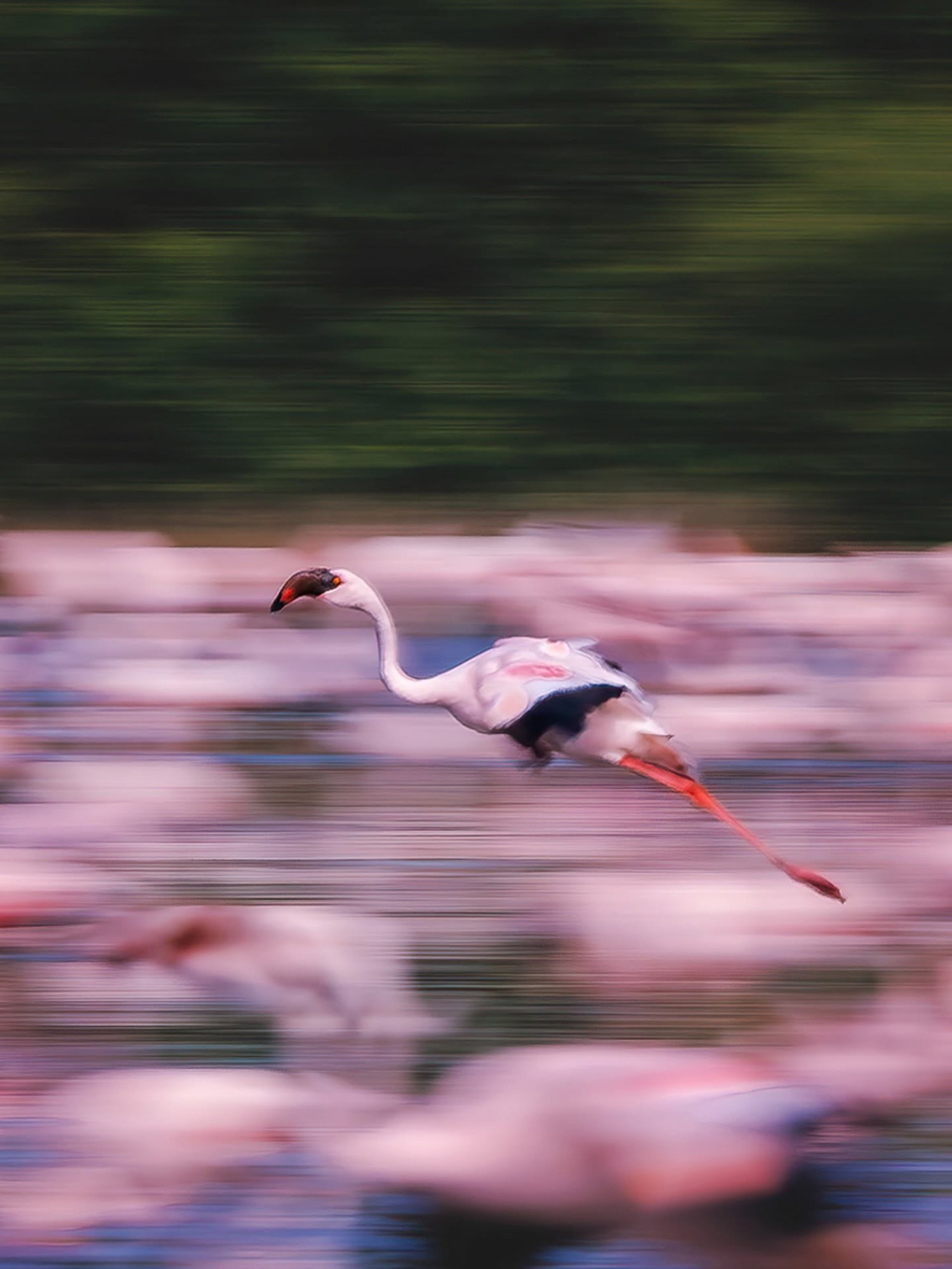
▪ To reach 9+, two things would need to align: the peak moment of the takeoff (wings fully extended, body lifting clear of the water) and a slower shutter speed that pushes the background flock into complete painterly abstraction while the primary subject remains sharp. That frame would show the singular bird at the exact instant of separation from the mass, with the flock rendered as pure colour and motion behind it.
▪ The habit that gets there: shoot the entire sequence, not just the first good frame. **Ernst Haas** built his career on motion studies like this — his running bulls, his bullfight series, his New York street pans — and he shot hundreds of frames to find the one where technique and peak moment coincided. Search: Ernst Haas motion photography. Your portfolio shows you are working cross-genre with consistent technical control — the next step is patience within the sequence.
SL Evaluation · Expert-calibrated
Master tier means the technique is no longer the challenge — you can execute panning cleanly and consistently, and the image shows that control.
To reach 9+, two things would need to align: the peak moment of the takeoff (wings fully extended, body lifting clear of the water) and a slower shutter speed that pushes the background flock into complete painterly abstraction while the primary subject remains sharp. That frame would show the singular bird at the exact instant of separation from the mass, with the flock rendered as pure colour and motion behind it.
The habit that gets there: shoot the entire sequence, not just the first good frame. Ernst Haas built his career on motion studies like this — his running bulls, his bullfight series, his New York street pans — and he shot hundreds of frames to find the one where technique and peak moment coincided. Search: Ernst Haas motion photography. Your portfolio shows you are working cross-genre with consistent technical control — the next step is patience within the sequence.
Next time you are at any wetland or lake where large birds are active — herons, egrets, pelicans, storks — try panning at 1/15s to 1/10s as they take off or land. Track the bird smoothly through the entire motion. The background will dissolve into streaks. The bird becomes a sharp subject inside pure energy.
YOUR NEXT BODY OF WORK SEQUENCE: The story is the collective and the individual — how one subject separates from the mass. Frame 1: the flock at rest, tightly packed, no individual readable — pure density and colour. Frame 2: this frame — one bird breaking free, sharp against the blurred mass, the moment of separation. Frame 3: the single bird in flight, clear of the flock entirely, alone against open sky or water — the resolution of the departure.
The photograph you almost made is always better than the one you settled for. The frame you are chasing is the one where you did not stop shooting half a second too early.
Decisively chosen — you committed to the panning technique and executed it cleanly, holding the primary flamingo sharp while the background flock and treeline blurred into horizontal motion streaks. Most photographers at this scene would have shot at 1/1000s and frozen everything. You made the harder call.
Ernst Haas built his entire motion photography practice on this principle — that blur reveals energy and emotion that sharpness cannot. His running bulls, his New York street pans, his bullfight series — all of them use slow shutter speeds and precise tracking to show the feeling of motion, not just the fact of it. Ernst Haas motion photography.
This image has a story because it shows the collective and the individual simultaneously — one flamingo breaking free from the blurred mass of the flock, the moment of separation made visible through the technique. That is not a nature record. That is a narrative decision.
What stood out
Confidently executed — you held the pan steady enough to keep the primary flamingo sharp while the entire background flock dissolved into horizontal motion streaks. That is not luck. That is tracking discipline and shutter timing working together. The image earns its energy from the technique, not from the subject alone.
▪ Next time you are at any wetland or lake where large birds are active — herons, egrets, pelicans, storks — try panning at 1/15s to 1/10s as they take off or land. Track the bird smoothly through the entire motion. The background will dissolve into streaks. The bird becomes a sharp subject inside pure energy.
▪ YOUR NEXT BODY OF WORK SEQUENCE: The story is the collective and the individual — how one subject separates from the mass. Frame 1: the flock at rest, tightly packed, no individual readable — pure density and colour. Frame 2: this frame — one bird breaking free, sharp against the blurred mass, the moment of separation. Frame 3: the single bird in flight, clear of the flock entirely, alone against open sky or water — the resolution of the departure.
▪ The photograph you almost made is always better than the one you settled for. The frame you are chasing is the one where you did not stop shooting half a second too early.
Confidently executed — you held the pan steady enough to keep the primary flamingo sharp while the entire background flock dissolved into horizontal motion streaks. That is not luck. That is tracking discipline and shutter timing working together. The image earns its energy from the technique, not from the subject alone.
Your next shot — bookmarked
Ranganathittu Bird Sanctuary
Ranganathittu Bird Sanctuary is nearby. December through February is peak nesting season for painted storks, spoonbills, and egrets — the island rookery is active from dawn through mid-morning. Arrive at 06:30 and position yourself at the boat jetty overlook. The frame worth making: a painted stork landing on a nest with wings fully spread, panned at 1/20s so the background trees blur into vertical streaks and the bird is sharp against pure motion.
Edit suggestions
Balanced · Light editing
Darken the top third of the frame slightly — the dark green treeline is competing with the flamingo for visual weight, and reducing its brightness by half a stop lets the pink subject dominate more clearly.
Increase vibrance on the flamingo's pink and red tones by one step — the motion blur has softened the colour slightly, and a targeted boost on the subject (not the background) will separate it further from the blurred flock.
Crop tighter from the right edge to remove some of the empty water space — the frame has more breathing room than it needs, and a tighter crop pushes the subject closer to the left third line and increases the sense of forward momentum.
Artistic · Heavy editing
Convert to black and white and push the contrast hard — the motion streaks become pure graphic energy, the flamingo becomes a white silhouette against dark horizontal lines, and the image transforms from a nature study into an abstract motion composition where the subject is shape and direction, not species.
How this photographer is developingLast 19 photographs
League standing is determined by calibrated evaluation against the Shutter League standard. Standings reflect evaluated photographs only.
Terms & Conditions ·
Privacy Policy ·
Refund Policy