Higher than 79% of images in the League. Master — Exceptional. Fewer than 1 in 10 reach this.
88.3510
✓ Apex DDI across 5 dimensions
✓ Expert review by Grandmaster mentor
✓ Final evaluation calibrated
Evaluated 06 Aug 2026 · Public
The five dimensions
Wonder Factor
8.9↑
Your Strongest
Timing
8.7
Strong
Emotion
8.4
Strong
Difficulty
8.2
Strong
Visual Impact
6.8↓
Your Next Leap
Tap a dimension to see the engine's reasoning · All evaluations out of 10
SL evaluation distribution
058.3510
What Shutter League saw
▪ This places you in the top 12% of Wildlife images evaluated on Shutter League.
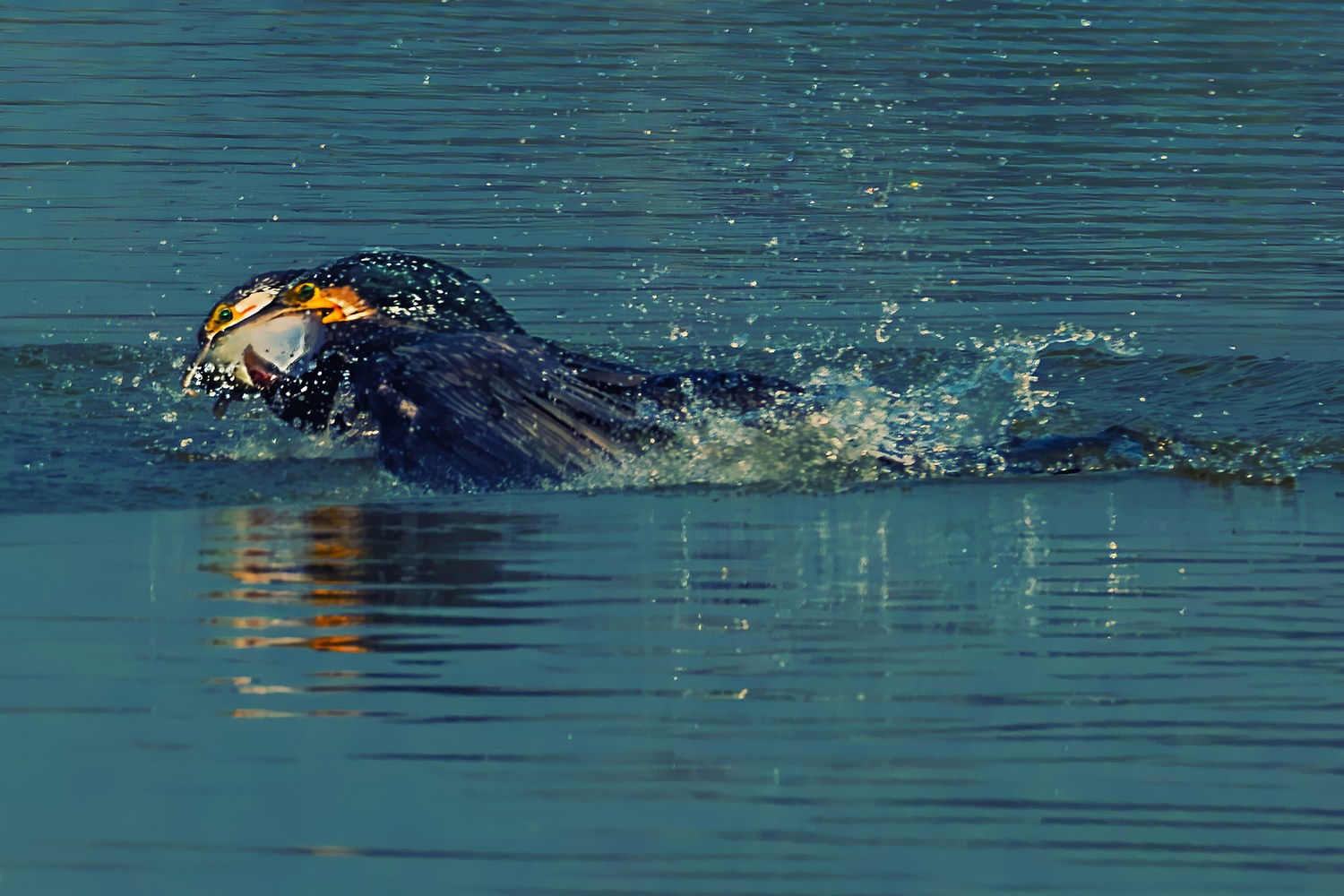
▪ At 9.0+, this frame would show the fish repositioned lengthwise in the bill — head-first, vertical, the instant before the swallow — with the same spray and sharpness you achieved here. That moment exists for 2-3 seconds after this frame, and it is the completion of the predation sequence that judges and editors remember.
▪ The habit that gets there: track the full behavioural sequence, not just the surfacing. **Nick Nichols** built his career on this principle — the frame that shows the consequence, not just the action. Search: Nick Nichols tiger kill sequence. Your trend: 3 wildlife evaluations in the last 6 months, average 7.8 — you are consistently capturing sharp action but the next step is anticipating the rarer moment within the action.
SL Evaluation · Expert-calibrated
This places you in the top 12% of Wildlife images evaluated on Shutter League.
At 9.0+, this frame would show the fish repositioned lengthwise in the bill — head-first, vertical, the instant before the swallow — with the same spray and sharpness you achieved here. That moment exists for 2-3 seconds after this frame, and it is the completion of the predation sequence that judges and editors remember.
The habit that gets there: track the full behavioural sequence, not just the surfacing. Nick Nichols built his career on this principle — the frame that shows the consequence, not just the action. Search: Nick Nichols tiger kill sequence. Your trend: 3 wildlife evaluations in the last 6 months, average 7.8 — you are consistently capturing sharp action but the next step is anticipating the rarer moment within the action.
Tomorrow morning, go to Hesaraghatta Lake or Ulsoor Lake at 06:30 — cormorants, egrets, and kingfishers are actively fishing in the shallows at dawn. Position yourself low, backlit if possible, and track one bird through multiple dives. Wait for the repositioning swallow, not just the surfacing catch. Bring your longest lens and a monopod.
YOUR NEXT BODY OF WORK SEQUENCE: The story is The Hunt — three frames that show predation as a sequence, not a single moment. Frame 1: A cormorant or kingfisher diving — the instant the body enters the water, spray exploding upward, the commitment. Frame 2: The surfacing catch — fish crosswise in the bill, exactly what you captured here. Frame 3: The repositioning swallow — fish vertical, head-first, throat working, the completion. Together, these three frames tell the full story of how a wild bird earns its meal.
The camera is just the tool. The real instrument is your attention.
Exceptionally patient — you tracked the cormorant through the dive and held position for the surfacing instant with prey visible, a decision that requires anticipating where the bird will break the surface and being ready with focus and shutter speed already set.
Ashok Kochhar teaches this exact principle in his field workshops — the predation frame is not the dive or the chase, it is the instant the prey is secured and visible. Ashok Kochhar kingfisher catch. Your image is one step from that level.
This image has a story because it shows the consequence of the hunt — the fish is held, the effort is visible in the spray, and the viewer understands what just happened underwater without needing to see it.
What stood out
Brilliantly timed — you held the shutter for the exact instant the cormorant surfaced with the fish crosswise in its bill, water spray suspended mid-cascade, and that half-second window is what separates a predation record from a generic water exit. The fish is clearly visible, the eye is sharp, and the spray pattern confirms you were tracking the dive and ready when the bird broke the surface.
▪ Tomorrow morning, go to Hesaraghatta Lake or Ulsoor Lake at 06:30 — cormorants, egrets, and kingfishers are actively fishing in the shallows at dawn. Position yourself low, backlit if possible, and track one bird through multiple dives. Wait for the repositioning swallow, not just the surfacing catch. Bring your longest lens and a monopod.
▪ YOUR NEXT BODY OF WORK SEQUENCE: The story is The Hunt — three frames that show predation as a sequence, not a single moment. Frame 1: A cormorant or kingfisher diving — the instant the body enters the water, spray exploding upward, the commitment. Frame 2: The surfacing catch — fish crosswise in the bill, exactly what you captured here. Frame 3: The repositioning swallow — fish vertical, head-first, throat working, the completion. Together, these three frames tell the full story of how a wild bird earns its meal.
▪ The camera is just the tool. The real instrument is your attention.
Brilliantly timed — you held the shutter for the exact instant the cormorant surfaced with the fish crosswise in its bill, water spray suspended mid-cascade, and that half-second window is what separates a predation record from a generic water exit. The fish is clearly visible, the eye is sharp, and the spray pattern confirms you were tracking the dive and ready when the bird broke the surface.
Your next shot — bookmarked
Hesaraghatta Lake
Hesaraghatta Lake is 45 minutes northwest of Bengaluru — cormorants, egrets, and kingfishers are actively fishing in the shallows at dawn right now in late winter. Arrive at 06:30, position yourself low and backlit if possible, and track one bird through multiple dives. The repositioning swallow — fish vertical in the bill — is the frame worth waiting for.
Edit suggestions
Balanced · Light editing
Darken the background water in the upper right quadrant — the bright patch is competing with the cormorant for the eye. Remove that competition and the subject becomes the clear focus.
Lift the shadows slightly on the cormorant's body — the dark plumage is merging with the water in the lower frame, and separating the body from the surface makes the low-in-water posture more readable.
Increase contrast on the fish — the silvery body is visible but not as distinct as it could be against the dark bill. A small contrast lift makes the prey undeniable.
Artistic · Heavy editing
Convert to black and white with a heavy blue channel filter — the water goes near-black, the spray becomes white graphic shapes, and the cormorant and fish become pure tonal contrast. The image stops being a nature record and becomes a study in predation geometry.
How this photographer is developingLast 19 photographs
League standing is determined by calibrated evaluation against the Shutter League standard. Standings reflect evaluated photographs only.
Terms & Conditions ·
Privacy Policy ·
Refund Policy