← Back to Dashboard
Shutter League Evaluation
Sri Chaitanya
Flamingos · Wildlife
✓ AI verified
◉ Calibrated · 312 images
★ Expert calibrated
Rookie
Shooter
Contender
Craftsman
Maverick
Master
Grandmaster
Legend
MAVERICK
7.32/10
Higher than 26% of images in the League
Wildlife
⚡
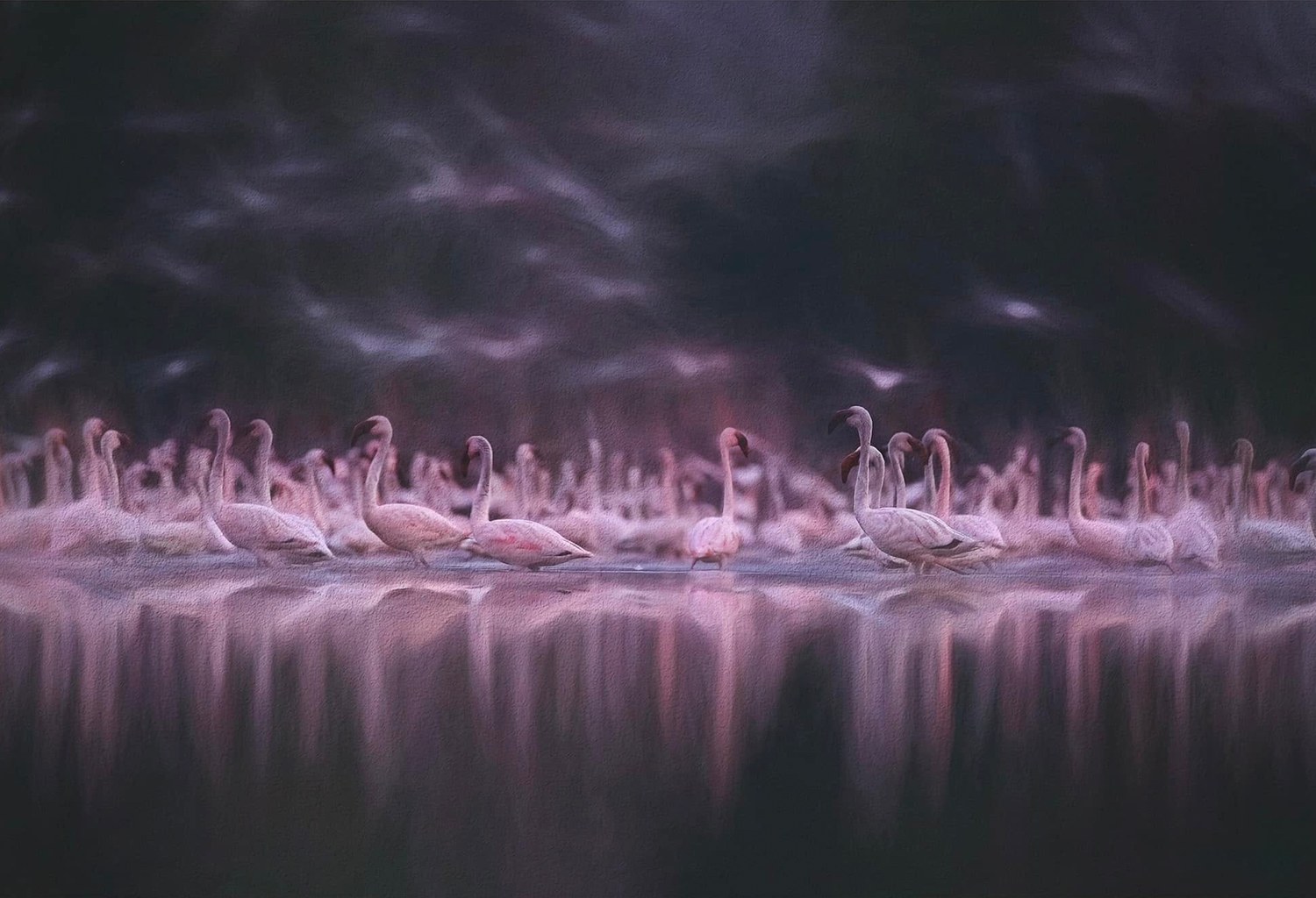
You positioned yourself at water level and let the shallow depth of field do the work — the flock rendered as soft colour fields rather than individual subjects, muted pink and grey against dark water. The painterly quality is a deliberate reduction decision, and it separates this frame from the saturated sharp-flock treatment most photographers bring back from wetlands.
Strength
Disruption — 7.80
The painterly rendering — extremely shallow depth creating soft colour fields, muted pink-and-grey palette, water-level perspective — departs from conventional flamingo flock photography and creates an atmospheric abstraction rather than a wildlife record.
Next leap
Timing — 6.20
The feeding posture is ambient behaviour that lasts for hours — the frame that scores higher is the one where a single flamingo breaks the pattern with head raised or wings spread, creating a peak instant inside the continuous rhythm.
The Five Dimensions
All evaluations out of 10 · Tap any dimension to see why
🏔️
Difficulty
7.2
—
Strong
⭐
Visual Impact
7.4
—
Strong
🎯
Timing
6.2
↓
Your Next Leap
⚡
Disruption
7.8
↑
Your Strongest
❤️
Emotion
7.1
—
Strong
7.2
Strong
🏔️
Difficulty
Water-level positioning with telephoto and shallow depth control is technically deliberate, but flamingo flock access near Bengaluru is well-established at multiple wetlands — the difficulty is in the execution and reduction decision, not in reaching the subject.
7.4
Strong
⭐
Visual Impact
Eye Wonder — the photographer found the soft colour-field treatment rather than the conventional approach, and the muted palette against dark water creates a painterly quality that transforms a common subject into an atmospheric abstraction.
6.2
Next leap
🎯
Timing
Feeding is continuous behaviour — flamingos feed for hours in shallow water, and the moment captured here is ambient rather than a specific peak instant that could not have been taken a second earlier or later.
7.8
Strongest
⚡
Disruption
The soft colour-field rendering and muted palette depart from the conventional sharp-saturated flamingo treatment — most photographers push the pink and keep every bird sharp, and this frame chose atmosphere over detail.
7.1
Strong
❤️
Emotion
Stillness and quiet — the soft rendering and muted tones create a contemplative mood rather than the vibrant energy most flamingo images produce, and a stranger would feel the calm before naming the subject.
Not sure
📖
Does the image have a story?
NOT SURE because the flock is clearly feeding and the behaviour is readable, but the soft rendering and lack of a single anchor subject mean the viewer sees atmosphere and colour rather than a complete narrative — the story is suggested but not fully resolved without knowing the context of wetland feeding ecology.
✓ Evaluated by SL · Expert-Calibrated
What this evaluation means
⌄
▪ A score at this level means the image made us feel something — the stillness here is real and a stranger would name it as calm or quiet before they name the subject.
▪ The 9+ version of this frame: same water-level perspective, same soft rendering, but the light is golden rather than overcast — warm rim light on the nearest flamingo necks, the pink glowing against dark water, and one bird with head raised creating a single point of alertness inside the feeding rhythm.
▪ **Vincent Munier** works this way with Arctic subjects — soft atmospheric rendering where the subject becomes colour and form rather than detail, and the mood is the image. You have the reduction instinct — the next step is waiting for the light that makes the reduction luminous rather than muted.
Quietly composed — you placed yourself at water level and let the shallow depth do the work, rendering the flock as soft colour fields rather than individual subjects. The muted pink-and-grey palette against dark water is a deliberate reduction decision, and it separates this frame from the saturated sharp-flock treatment most photographers bring back from wetlands.
SL Evaluation Distribution
058.510
📍 Your next shot — bookmarked
Jakkur Lake is nearby — the painted storks and spot-billed p
Jakkur Lake is nearby — the painted storks and spot-billed pelicans are active now in early morning light, and the water level is low enough to position yourself at the shoreline for the same water-level perspective you used here. The frame worth making: a single stork feeding with bill submerged, soft-rendered flock behind, golden light on the neck.
Go shoot →
Master reference
Lanting waits for the light that makes the reduction luminous — golden rim light on necks, pink glowing against dark water. You have the reduction — wait for the glow.
Technical read
The in-focus band is narrow — only the middle-distance flamingos hold relative sharpness while foreground water and background flock dissolve into soft blur, confirming extremely shallow depth of field at a long focal length. The dark background is manufactured — either shadows crushed in post or an ND filter used to isolate the flock, not a night shot or underexposure. The muted colour palette is a tonal decision that creates mood over vibrancy, and it works because the soft rendering supports it.
Visual flow
Eye enters at the middle-distance flamingos where relative focus holds, travels left to right along the feeding line, then dissolves into the soft pink background — the dark water and overcast sky create a frame that holds the eye on the flock, but the lack of a single anchor subject means the eye moves through rather than rests.
Imagine
Imagine if this moment comes again at golden hour — same water-level perspective, same shallow depth rendering the flock as soft colour fields, but now warm rim light catches the nearest flamingo necks and the pink glows against dark water instead of reading muted. One flamingo lifts its head, alert, while the rest feed — that single break in the pattern becomes the anchor the eye needs, and the soft atmospheric rendering shifts from ambient to intentional. The muted palette becomes luminous, the stillness becomes presence, and the frame holds.
Your next body of work
The next image in this body of work shows a single flamingo feeding at dawn, head submerged, water droplets falling from the bill as it lifts — the intimate detail inside the abstraction you created here, golden light on the neck, sharp subject against soft-rendered flock behind.
The second frame shows the flock at dusk, the light fading, the pink turning to grey — the same muted palette but now the mood is departure rather than presence, and the stillness becomes melancholy.
The third frame shows the wetland empty, water reflecting the last light, a single flamingo silhouette walking away from camera — the solitude after the flock has left, and the story completes from abundance to absence.
The fourth frame shows the wetland at midday, harsh light, the flock scattered and resting — the unglamorous reality between the golden-hour frames, and the honesty that makes a body of work credible rather than curated.
Your path to recognition
The League of Photographers features genuinely international work — images that stand a chance for recognition, earn income through commissioned work, sales and print editions, and be featured in exhibitions, grants and awards.
Edit suggestions
Balanced · Light editing
▪ Lift the midtones slightly on the in-focus flamingos — the muted palette works but the birds are reading slightly underexposed relative to the dark water, and a gentle lift would separate them more clearly without losing the atmospheric mood.
▪ Darken the upper-left corner where faint pink shapes are visible — those out-of-focus birds in the background are creating a secondary visual weight that competes with the middle-distance flock, and removing them entirely by darkening that area would simplify the composition.
▪ Add a subtle vignette to the edges — the frame is already dark but a gentle vignette would pull the eye toward the centre band of birds and reinforce the isolation effect the shallow depth is creating.
Artistic · Heavy editing
▪ Develop a distinctive colour treatment and push the contrast — the soft pink becomes soft grey, the dark water becomes pure black, and the image shifts from painterly colour field to high-contrast abstraction where the flamingo forms read as graphic shapes rather than birds.
You keep finding the reduction — the decision to render the subject as colour and form rather than detail. Your Creative work evaluates at 8.10 on average. Your Wildlife work is at 7.31. The gap is not the engine — it is the light. Your Creative frames have the light that makes the reduction luminous. Your Wildlife frames have the reduction but the light is often overcast or flat. Fix that one thing and your Wildlife evaluations will follow
An image at this level belongs in the League of Photographers — where it earns a world standing calibrated against every photographer on the platform
The standard we are measuring against was built from hundreds of blind calibrations — not preference, not taste — what makes an image hold attention, create feeling, and outlast the five seconds it gets on a feed.
Evaluation record
Evaluated for
Sri Chaitanya
Date
26 Sep 2026
File
Flamingos
Genre
Wildlife
Species and behaviour
Greater Flamingos are filter feeders — they submerge their bills upside-down in shallow water and pump water through comb-like structures to trap algae and small invertebrates, and this feeding behaviour can continue for hours without interruption.
This evaluation was generated by the Apex DDI Engine — an AI system trained on calibrated photographic assessment. Evaluations are a creative and technical guide and may contain errors.
Flamingos · Wildlife